The Quiet Gap in Diaspora Homes: When Your Child Cannot Understand Their Own Grandmother
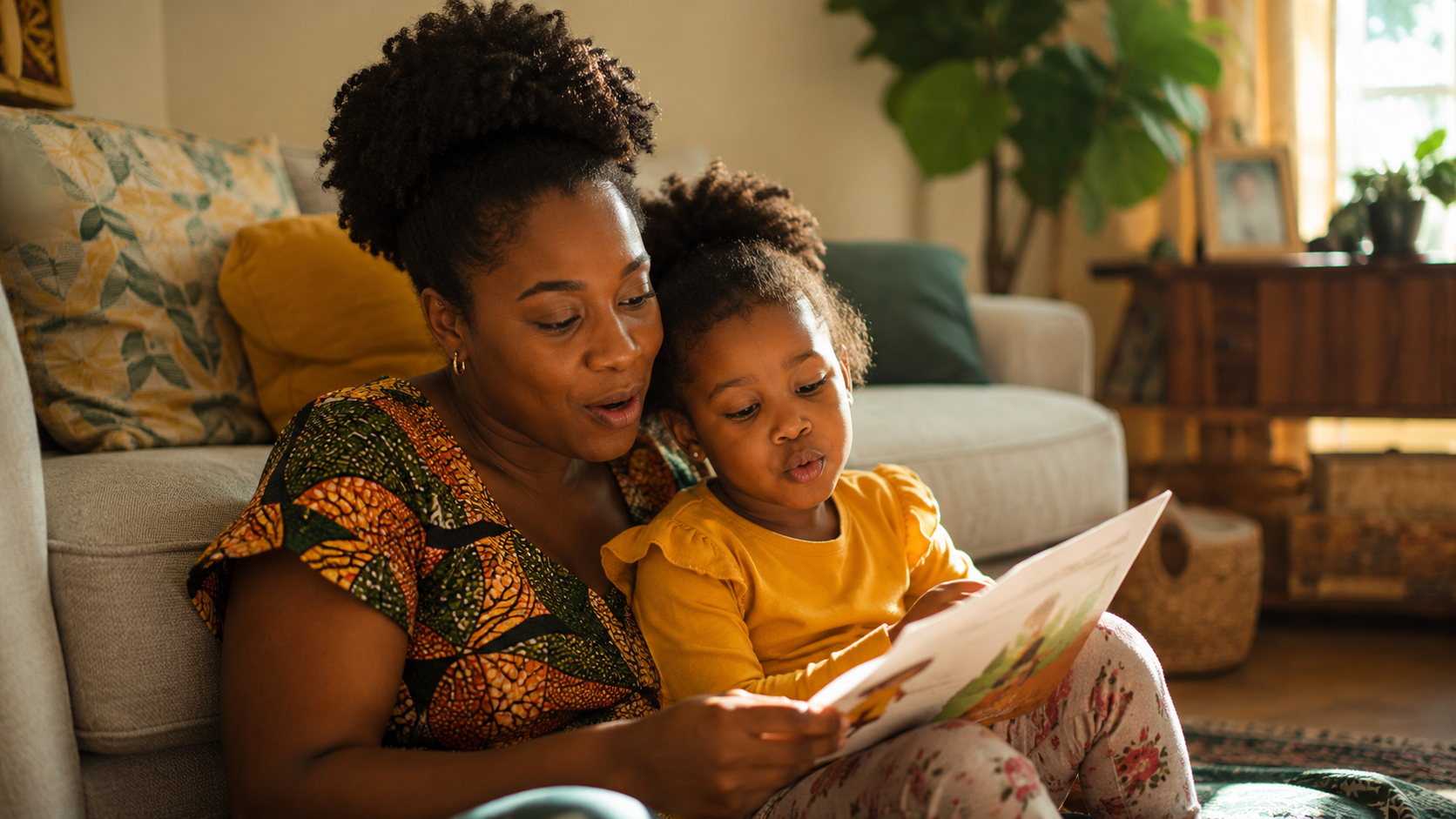
Over the past two years, Adejoke Y. Oluwajobi has spent hundreds of hours speaking with diaspora mothers across the UK, the US, Canada, and beyond, researching what actually works when it comes to teaching Yorùbá to children raised outside Nigeria. She has read the studies. She has interviewed the language teachers. She has sat with grandmothers who raised bilingual children without ever calling it a “method.”
Of all the stories she collected, one stopped her completely.
What follows is a family’s real experience, shared with full permission. The mother’s name has been changed to protect her privacy. Everything else happened exactly as described.
There is a moment that thousands of Nigerian parents in the diaspora recognise instantly. It happens at a dinner table, or during a phone call, or on a Sunday afternoon when the grandparents are visiting. The parent speaks Yorùbá to their child, and the child looks back with a blank, slightly confused expression.
Not rude. Not defiant. Just empty. As though the parent had just spoken a completely foreign language to the child who shares their blood.
For many families, this moment passes quickly. The parent switches to English, the conversation continues, and nobody mentions it. But something tightens inside. A quiet shame. The kind that does not get talked about at dinner parties.
This experience reflects a challenge faced by thousands of Yorùbá families in the diaspora. And for one South London mother, it became the beginning of a journey that would change her family completely.
Meet Ada: A Story Many Diaspora Parents Will Recognise
Ada is a 34-year-old Nigerian-British mother living in South London. Yorùbá mother from Ibadan, Igbo father from Enugu. She has a five-year-old daughter named Zara.
Like many parents who grew up hearing Yorùbá at home, Ada understood far more than she could comfortably speak. She always assumed her daughter would simply absorb the language the way she had growing up. What happened instead is something thousands of diaspora families quietly experience: the language slipped away, one generation at a time, without anyone noticing until it was almost too late.
Ada is not a language teacher. She has no letters after her name. No qualifications to hang on a wall. But what she discovered, almost by accident, eventually cracked the code on teaching Yorùbá to a diaspora child.
The Moment That Changed Everything
February 2023. Zara was three and a half. Ada’s mother, whom the family calls Mama Ibadan, was on a video call from Lagos.
Zara stared at the screen. Then she turned to Ada and said: “Mummy, what is Mama Ibadan saying? I can’t understand her.”
Ada’s mother went quiet. A few moments later, she said something in Yorùbá that Ada will never forget:
“Ada, when I’m gone, who will this child talk to about where she came from?”
The call ended shortly after. Ada sat on the bathroom floor and cried. The ugly, hiccuping kind. The kind you do behind closed doors so your child does not see.
This experience will sound painfully familiar to many diaspora parents. The video call that goes silent. The grandmother who tries to speak Yorùbá and gives up after thirty seconds. The private guilt that settles in the chest and never quite goes away.
Everything She Tried That Did Not Work
Over the next two years, Ada tried everything she could find.
YouTube. Zara lasted four minutes before asking for Bluey. Duolingo. No Yorùbá available. Deleted. Saturday Yorùbá school. £35 per session. Zara cried three Saturdays in a row. Ada paid for eight sessions; they attended four. The child retained approximately nothing. A Zoom tutor found on Facebook. Three sessions, then the tutor vanished. A phrasebook from Amazon. Opened twice. Gathered dust for eight months.
Almost two years had passed. Zara still could not speak a single Yorùbá sentence.
What makes Ada’s story so common is that none of these things are bad resources in isolation. The problem, as she would later discover, was not the tools. It was the approach. Every single method she tried treated Yorùbá as a school subject to be studied, rather than a living language to be woven into daily life.
The Day She Met Iya Bunmi
October 2023. A Nigerian community harvest thanksgiving at a church hall in Peckham. An older woman came and stood beside Ada at the food table. Small. Maybe five feet tall. Printed adire blouse, reading glasses on a chain. Seventy-four years old. A retired primary school teacher with thirty-one years of experience in Ibadan.
Her name was Iya Bunmi. And what she told Ada over the next two hours would change Ada’s family permanently.
“You’ve been trying to teach your daughter Yorùbá the way English people teach their children French. As a subject. As a lesson. That is why it is not working. A language is not a subject. It is a life. The grandmothers didn’t sit children down and say ‘Now we will learn Yorùbá.’ They just... spoke. At bath time. At mealtime. During stories at night. They wove the language into the child’s daily life until the child couldn’t tell the difference between living and speaking Yorùbá. That is what you must do.”
Iya Bunmi spent thirty minutes explaining her method. Short, daily moments of Yorùbá woven into breakfast, bath time, and bedtime. Songs, games, and phrases introduced through action rather than translation. Fifteen minutes a day, embedded into what the family was already doing.
What surprised Ada most was how simple it sounded. Not easy, exactly. But simple. There was no curriculum. No homework. No pressure to get everything right. Just a daily rhythm, consistent and warm, that made the language feel like part of the furniture rather than a task on a to-do list.
Before Ada left, she asked one final question: “But what if I’m not fluent enough?”
Iya Bunmi gave her a look that Ada later described as “a gentle slap delivered entirely through eye contact.”
“You are the child’s mother. That is enough. Start. Don’t wait until you are ready. You will be ready when you start.”
Day 9: The Breakthrough
Ada started the method the following Monday. By Day 7, she was close to writing it off. The greetings were landing, but Zara seemed to be going through the motions rather than truly absorbing anything. Ada felt the familiar pull of disappointment.
Then Day 9 happened.
Ada was in the kitchen making egusi soup. Zara walked in and said, completely unprompted:
“Mummy, mo fẹ́ jẹ spaghetti.”
“Mummy, I want to eat spaghetti.”
She had not been prompted. She did not look to check if she had said it correctly. She just said it. Naturally. The way a child says anything they actually know.
Ada stood at the stove and could not move for ten seconds. Then she picked her daughter up and swung her around the kitchen.
For parents who have experienced this moment, no explanation is necessary. For parents who have not, no explanation is sufficient. It is the moment you realise the method is not just working in theory. It is alive in your child.
Day 30: The Call That Changed Everything
Ada set up a video call with her mother. Zara looked at the screen and said:
“Mama Ibadan, mo wà dáadáa. Mo fẹ́ wá rí yín. Mo nífẹ̀ẹ́ yín.”
“Mama Ibadan, I am fine. I want to come and see you. I love you.”
Ada’s mother cried. Ada cried. Zara looked at both of them with the satisfied expression of a child who knows she has done something extraordinary.
What had changed was not Zara’s ability. It was never about ability. What changed was the method. Fifteen minutes a day, woven into the routines of breakfast, bath time, and bedtime, had done what two years of Saturday schools, apps, and phrasebooks could not.
When Ada shared her experience, Adejoke Y. Oluwajobi knew this was more than one family’s success story. She asked Ada to share Iya Bunmi’s method in full. Then she spent several months verifying it with linguists, testing it with 12 diaspora families across the UK, US, and Canada, refining it with a Yorùbá language consultant, and documenting every step into a clear, structured guide that any parent could follow, regardless of their own fluency level.
Every word and phrase was checked for correct tonal notation. Because the worst thing a parent can do is teach their child Yorùbá with the wrong tones. This guide makes sure that never happens.
The result of that work is now available.
in 30 Days
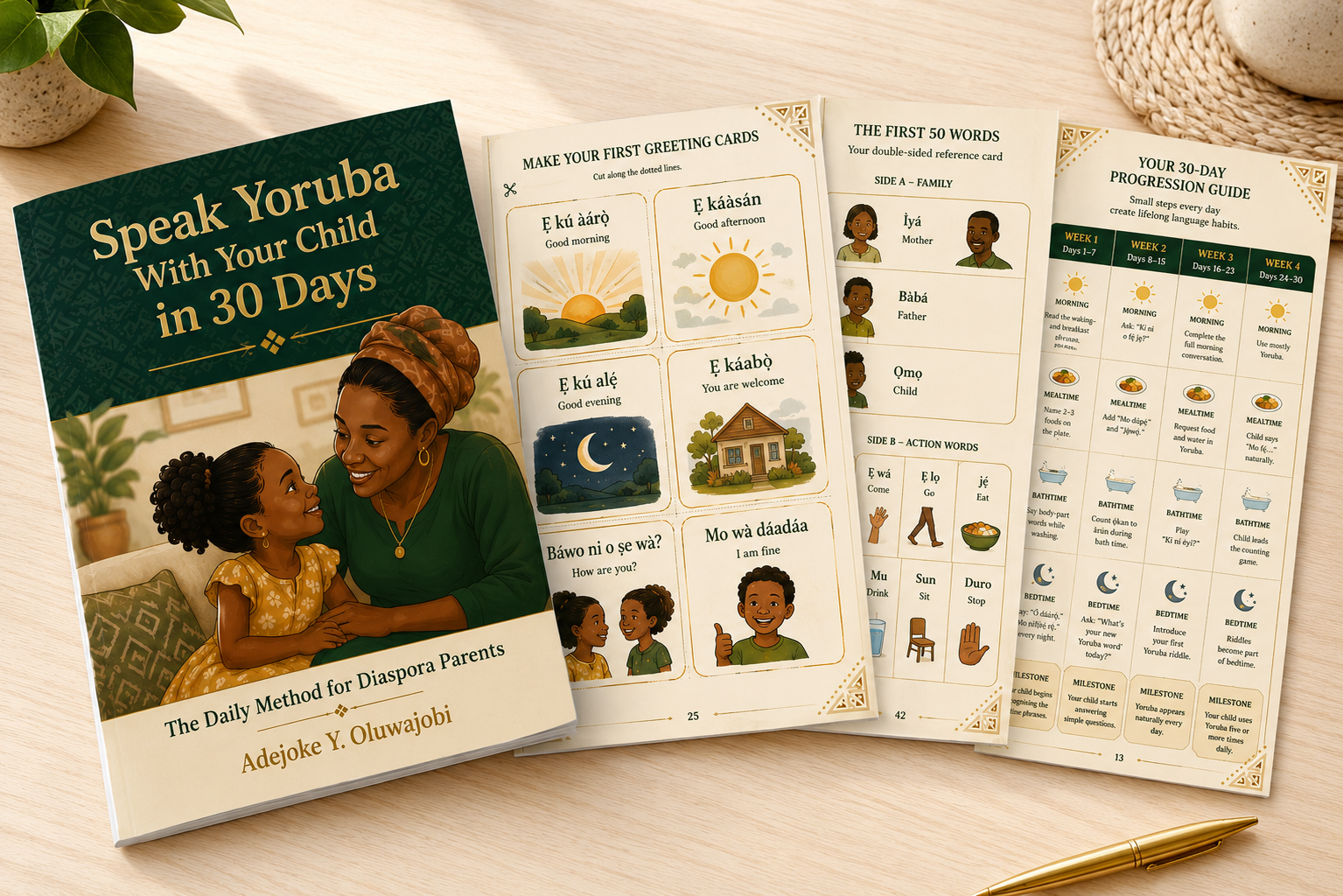
What the Guide Contains
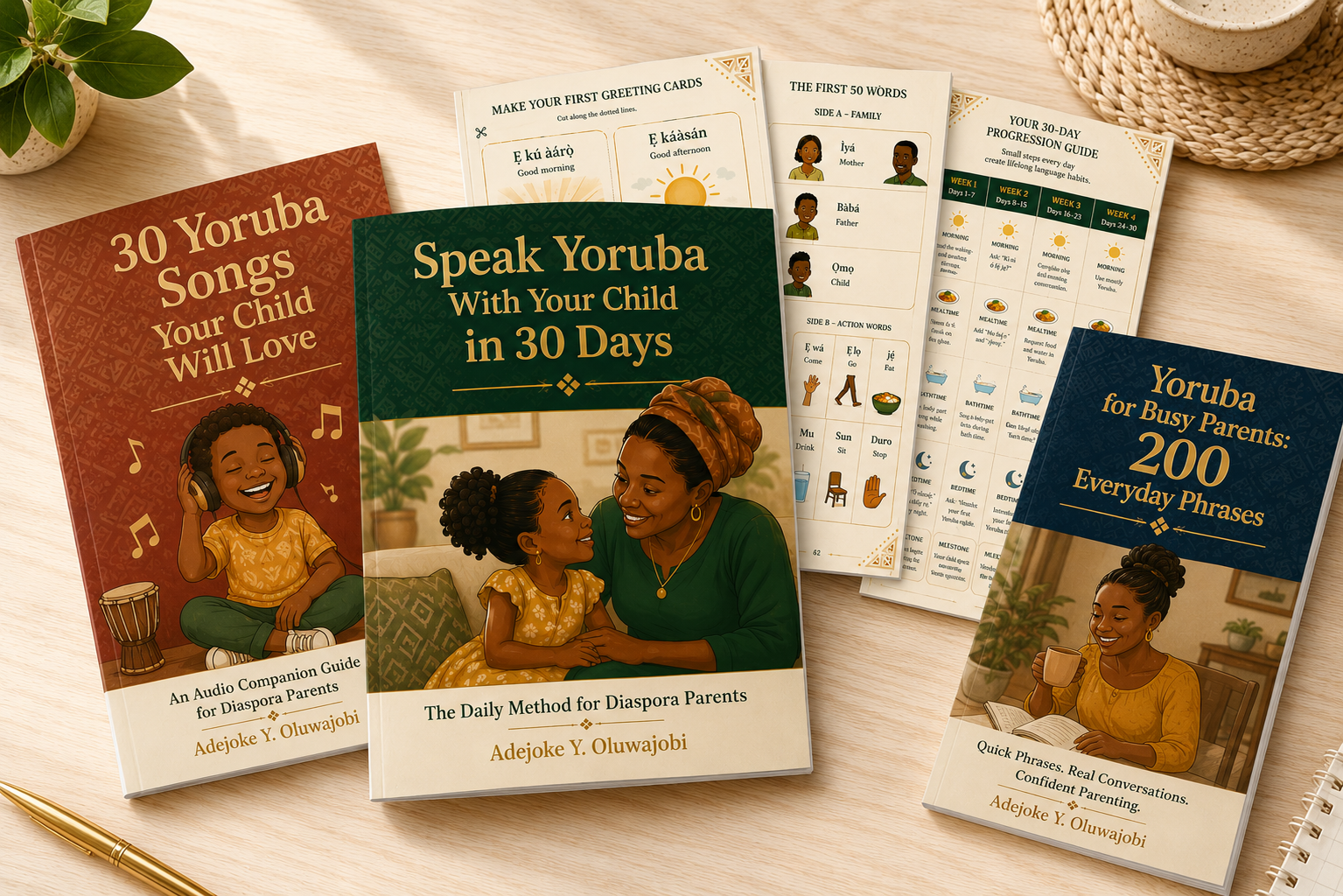
- ✓The 30-Day Daily Rhythm PlanThe exact schedule of fifteen-minute daily activities that builds Yorùbá into the child’s normal routine. Not as a lesson, but as a way of living.Pg. 4 | The Foundation Method
- ✓The “First 50 Words” SequenceThe specific Yorùbá words every diaspora child should learn first, in the exact order that makes new words easier to absorb, with tonal pronunciation guidance for each one.Pg. 12 | Words That Stick
- ✓The Daily Life ScriptsWhat to say at breakfast, during the school run, at bath time, and at bedtime, so the parent is building Yorùbá all day long without sitting down for a single “lesson.”Pg. 22 | Speaking Into Their Day
- ✓The Resistance MethodExactly what to do when the child refuses or says “I don’t want to speak Yorùbá.” Five response scripts that turn resistance into curiosity without a single argument.Pg. 34 | When They Push Back
- ✓The “Even If You’re Not Fluent” SectionFor parents who understand Yorùbá but cannot speak it confidently. How to teach what they half-know and grow alongside their child.Pg. 40 | The Imperfect Parent’s Guide
- ✓The Grandparent BridgeHow to use video calls with elders back home as the most powerful part of the method, including suggested call activities and phrases to practise before each call.Pg. 52 | Connecting Across Continents
My twin girls are 4 and the Saturday school here was not doing anything. The method makes so much sense. You are not teaching them Yorùbá, you are helping them LIVE in Yorùbá. By week two they were arguing with each other in Yorùbá! ARGUING! The resistance section alone is worth the price. 10/10 no question.
My daughter is 8 and I thought it was too late. After 28 days with this guide she sang a full Yorùbá children’s song at our church programme. The whole congregation was in shock because this same child was forming “I don’t understand” for years. Thanking God for this work.
Even as someone living in Nigeria I had started to notice my children responding to me in English. The Daily Life Scripts changed our whole home atmosphere. Now Yorùbá is our morning language. Highly recommend for ANY Yorùbá parent not just diaspora.
I have been in Atlanta for 12 years and my children speak zero Yorùbá. The “Even if you’re not fluent” section had me emotional. 30 days later my 9-year-old had a full conversation with her grandfather on the phone. I cannot explain to you what that meant.
This was not assembled in a weekend. Here is what went into producing it to a professional standard:
- Professional Yorùbá language consultant, verifying every phrase, every word, every tonal marking: ₦62,000
- Tonal notation review and audio script preparation, ensuring no parent teaches their child incorrect pronunciation: ₦38,000
- Professional layout and ebook design: ₦34,000
- Testing with 12 diaspora families across UK, US, and Canada: ₦42,000
- Platform, delivery, and website setup: ₦11,500
The guide is not priced anywhere near what it cost to build.
Not ₦187,500. Not ₦93,000. Not ₦50,000. Not even ₦20,000.
One-time payment · Instant digital delivery · Yours to keep forever
Pay in ₦ via Selar · Pay in $ via Nestuge
+ Both FREE Bonuses Included
+ Both FREE Bonuses Included
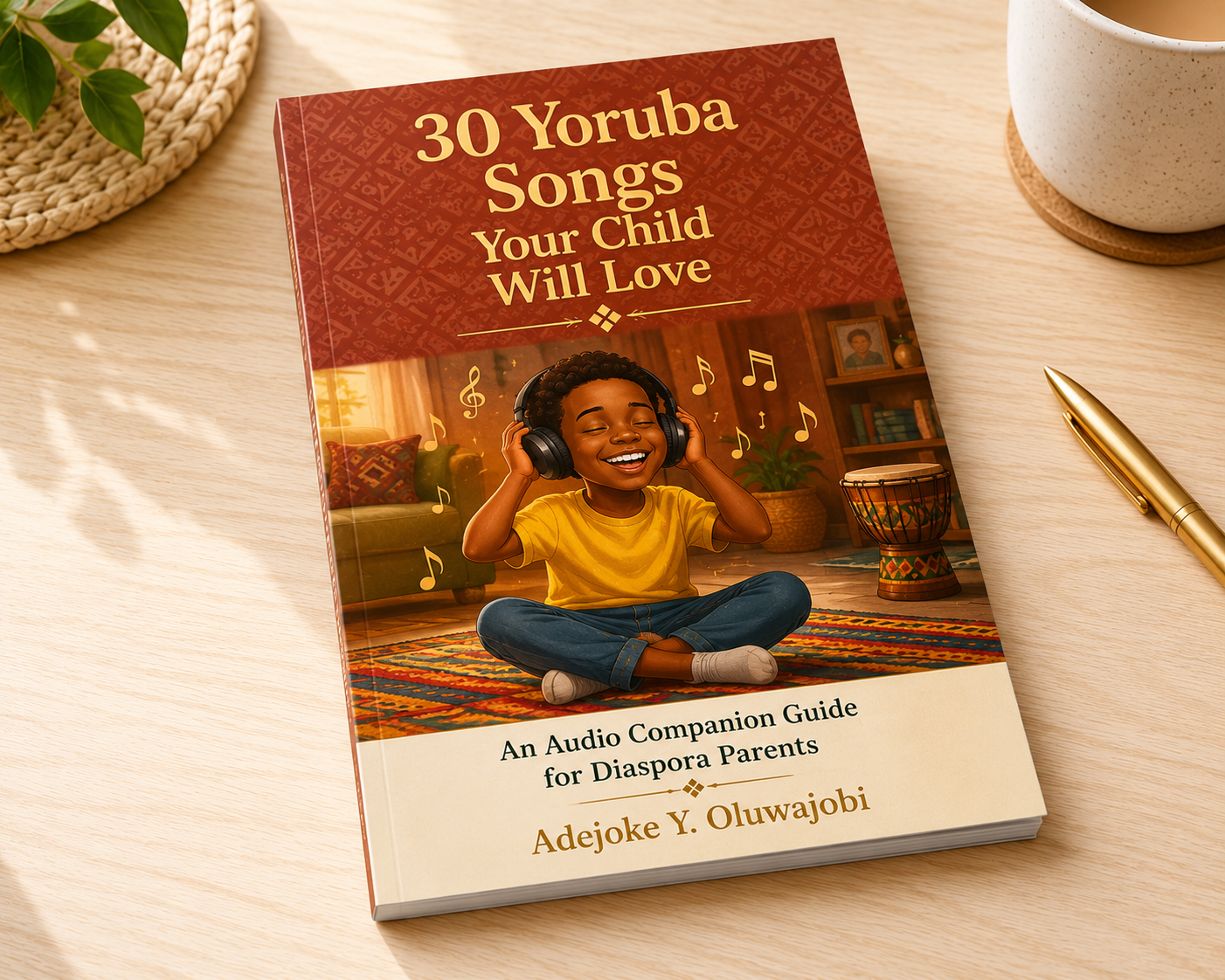
Traditional and contemporary Yorùbá children’s songs, complete with phonetic lyrics, English translations, and a pronunciation guide for every song. Music is the fastest way into a child’s language memory.
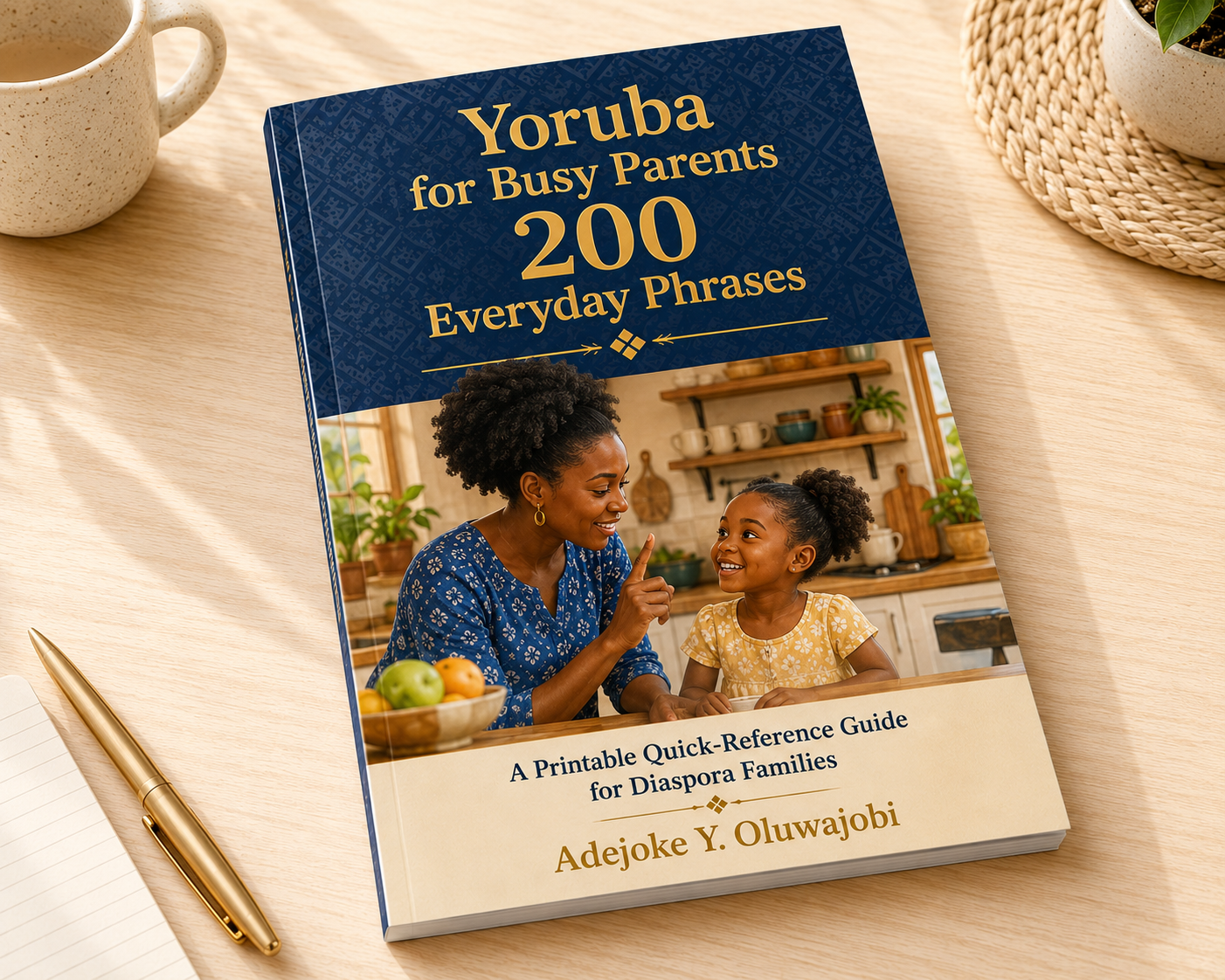
200 practical phrases organised by the moments of the day: morning, mealtime, school run, bath time, bedtime. Print it, stick it on the fridge, and start speaking Yorùbá into the child’s life from the very first morning.
Any parent who follows this method for 30 days, genuinely and daily as the guide instructs, should see their child learn at least 20 Yorùbá words and 5 complete sentences. If that does not happen, a full refund is available. No forms. No questions. No awkwardness. Just an email to abebiyoruba1@gmail.com.
30-day money-back guarantee · No questions asked · Full refund if the child doesn’t show measurable progress
My son is 9 and I honestly thought we had missed the window. This guide proved me wrong. The method works at any age. My son now greets my mother in proper Yorùbá every Sunday and she’s so proud she tells everyone in our family about it.
As a dad I felt embarrassed that I didn’t know where to start. After 30 days I played a voice note of my daughter speaking Yorùbá to my father in Ibadan. He didn’t speak for almost a minute. Then he said “Idowu, you have done well.” That’s all I needed.
My children go to an international school and their English was stronger than their Yorùbá. Now Yorùbá is our morning language and English is everything else. My children’s Yorùbá is sharper than many of their cousins already.
We are in Toronto and finding any Yorùbá resources here is almost impossible. This guide was the answer to what I have been looking for for FIVE years. The bonus songs alone are everything. My 3-year-old now requests Yorùbá songs at bedtime.
My niece messaged me after Week 3 saying her daughter counted to ten in Yorùbá at dinner and the whole table went silent then erupted. She said she cried in the kitchen afterwards where no one could see. This is exactly what diaspora parents have been carrying.
What Ada’s Story Means for Other Families
Ada’s experience is not unique. It follows a pattern that linguists and heritage-language researchers have documented across immigrant communities worldwide: the language thrives in the first generation, weakens in the second, and disappears in the third unless someone deliberately intervenes.
What makes this guide different from the Saturday schools and apps that failed Ada is not complexity. It is the opposite. The method works precisely because it does not ask families to add anything new to their day. It asks them to say what they were already going to say, but in Yorùbá. Breakfast still happens. Bath time still happens. Bedtime still happens. The only difference is the language those moments are wrapped in.
For parents reading this who recognise Ada’s story in their own family, the question is not whether the method works. The results from 140 families have answered that. The question is whether today is the day they decide to start.
Questions? Email abebiyoruba1@gmail.com
Results may vary. The 30-day guarantee covers cases where the full daily method was followed as instructed.
This website is not part of the Facebook website or Facebook Inc. Additionally, this site is not endorsed by Facebook in any way. FACEBOOK is a trademark of FACEBOOK, Inc.
This page contains editorial and promotional content. Results described are not typical and individual results will vary based on effort, consistency, and other factors. Testimonials reflect real experiences but outcomes may differ.
The parent featured in this article shared her story with full permission. The name “Ada” is used to protect her privacy. Adejoke Y. Oluwajobi is the researcher, compiler, and publisher of the guide.
The 30-day refund applies only where the full daily method was followed as instructed with proof provided.
© 2025 Àbẹ̀bí Yorùbá · Adejoke Y. Oluwajobi. All Rights Reserved. | abebiyoruba1@gmail.com
This guide is not a joke o. I started with my son Tobi (7 years) three weeks ago. Yesterday he came to me and said “Mummy, mo fẹ́ oúnjẹ”, completely by himself. I had to call my mother immediately. She was crying on the phone. We have been trying for three years and THIS is what finally worked. The daily scripts are everything. Buy it. Do not think about it.